Showing posts with label Debugging. Show all posts

Friday, June 22, 2007

"Change Your Password!" or Not?

Today I came across an article at the "Daily Cup of Tech" blog where the author urges you to frequently (every month or two) change your password(s). At first this may seem like a really good idea but I'll have to disagree. First of all let me point out some other password-related security guidelines.

One should never use the same password in all of his accounts. Should one of them be compromised, he is totally helpless. For example your password to a forum should never be the same as the password in the e-mail address you have provided during registration. Most people have two or three passwords and use one of them for their "most-secure" accounts, the second one for their e-mails and the third for every other "low-security" case. I'm not necessarily saying that's the best one can do. Also, passwords should be hard to guess (and therefore hard to remember). So a totally random combination of letters, numbers and symbols, longer or equal to 8 characters is a nice choice.

Let's get back to the article. Having at least three totally random passwords like "C9U6h#*U" or "swa!Es7u" is already a hard thing to do. Frequently changing them and therefore memorizing them every month or so is something nearly impossible for the average user. Too much effort can push one into writing down the password or storing in somewhere like on his cell phone. This is far worse than keeping the same password for a long time.

In my opinion, a secure-enough password is not in any danger from contemporary password-guessing techniques. The only way it can be compromised is if transmitted over an insecure medium, like a non-SSL HTTP session.

Monday, April 02, 2007

Software Leftovers

Don't you just hate it when, after you've uninstalled a game or application from your Windows PC, you get all kinds of leftovers? It usually is the installation directory, empty. It may also be a registry key, no longer necessary. And the question is why.

Why do these people write so lousy uninstallation routines that leave annoying garbage behind? One would think I am talking about some third-class piece of software but no. I am talking about very popular games and applications by well-known, well-respected companies.

Maybe it's the whole "Windows Attitude" to spread files here and there, register a couple of components and forget half of them behind in the end. Maybe they just think nobody will ever want to remove their program (cause it's "so cool").

Being a programmer myself, I find it really irritating when others fail to do their job. Over time you will get a PC which will be slower due to a large number of redundant file system and registry entries that still have to be parsed by the OS. And of course there is the aesthetic part which calls for a nice "clean" system.

I want to look at my hard disk and find my currently installed software and files and NOT a history of my activities over the last two years. Is that too much to ask?

Wednesday, February 21, 2007

Auditing Wi-Fi Areas.

I've always been curious about the kind of security applied in “Hot Spots” or “Wi-Fi Areas”. These are places where you can access the Internet on pre-paid time. I'm not even going to talk about securing the client's activities and data or providing any kind of anonymity. I was really keen on finding what means such providers have deployed to make sure no unauthorized personnel has access (aka people who haven't paid for their time). So today was my lucky day. While waiting for a flight at Athens International Airport I had the chance to test their Wireless Internet Access Service. Apparently they don't use any kind of encryption on their Access Points. That means anyone can connect to it and receive an IP Address through DHCP (Dynamic Host Configuration Protocol). That's good right? These guys want even the least tech savvy user to be their client. As soon as you try to access your first web site (I'm guessing they offer HTTP only), you are redirected (through a transparent proxy) to a login screen and asked for a PIN which can be found on the back of pre-paid cards. When you enter a valid PIN, (I'm guessing) your IP and/or MAC Address are recorded and their firewall let's you out (or your proxy fetches stuff for your or something like that). So, that's how it works.

Let's say I am a bad guy, well not a bad guy – just a guy who doesn't want to pay. I would go and sit next to a guy who is already surfing, sniff the unencrypted air to easily discover the legit user's IP and MAC Addresses. (Of course I could also sniff sensitive information such as his passwords or e-mails but that's another story.) After that would I configure my own wireless card to use the exact same information (hence masquerading my self as the legit user) and I'm in! That's it! I wouldn't even have to try to find holes in their firewall or crack their infrastructure or brute force PINs. Pretty easy huh? Well, it is.

Then I tried to understand it. First of all their administrator has applied no access control mechanisms to the Access Point because that would require a significant trade-off. It would require every user to know how to configure his wireless device to conform with those security systems (e.g. MAC Filtering, Hidden ESSID, WEP, WPA). This could scare away potential customers who just don't get along with computers very well and the CEOs don't want that. So no “frustrating” security measures.

OK so a lot of people can get it for free. We know it and they know it. Although at first it may seem that a bandwidth piggyback is so cool and let's you surf for free, it actually works in their favor. How?

First of all, including the piggybackers, more people will appear using their Wi-Fi Areas. And, as we all know, people tend to imitate other people's behavior. So if you have a wireless-capable device and see other people using such service you will also feel the urge to use it. So there you have, indirect advertisement! Moreover, people able to perform such stunt will be so proud of themselves that will tell their friends about it. And when their friends try to do it for themselves they may fail but they were expecting Internet Access on the spot so it is very likely they will actually pay for the service after all. Extending that, there will be a time the original hacker won't be able to find victims to take advantage of but going online from the airport may already have become a habit to him or somehing he relies on so even he may purchase credits for the service. Also, if you come to think about it, they providers aren't losing that much. Most users (even unauthorized ones) are there to catch a flight so under normal circumstances that won't take more than a couple of hours. It's not like they are stealing bandwidth for days or so.

To sum up, what is advertised and offered, is Internet Access to counteract those long waiting hours or allow one urgent e-mail to be sent or a short chat to be conducted. In other words it addresses the need for communication, something people are always willing to pay (a lot) for. The generics of this, who pays for it, who doesn't, how secure and reliable it is, are not considered (although they should be) important both by the provider and the majority of users so everyone is happy at the end of the day.

Tuesday, January 30, 2007

Imbalanced (IMBA) Corporate Security.

It seems that both corporate networks and their physical installations may be compromised because of some irresponsible security officer.

When we are talking about security (at a corporate level) we imagine an area (or multiple areas) where only certain people are allowed in. And once they are in, they are divided into groups depending on what they are meant to do in that area. That area may be a physical location (office/building). In there, only the company employes are granted entry priviledges. Once they are in, each one works in his own cubicle and only senior employes wonder around checking everybody else. This is the same when it comes to an electronic network: you have different areas (subnet A, subnet B, etc) and different kinds of permissions (server 1 access, server 2 access, etc).

Security officers are mostly concerned about letting people in. When a new guy is hired they screen him and watch him for a while before granting him appropriate permissions. The problem is that administrators are selfish creatures. If they say you are "OK", that's it. They never check up on you or re-evaluate their decision.

This is bad enough but the problem starts when they forget about you even when you leave the company for ever. As a result, active accounts of ex-employees remain in the system allowing them access at any time. This is huge! It only takes an unhappy ex-employee with the appropriate privileges and maybe a little hacking to enable stealing or destroying information or damaging the infrastructure itself.

It's been over a year since Bob left the company his was working at. A few days ago he realized that his network access had NOT been revoked (and - I bet- neither had his physical privileges, alarm codes etc). He was able to remotely access specific systems from the company network and gain administrative privileges. He could install backdoors in those systems to ensure future access. He could use those systems to attack others, sniff the inside of the company's network (firewalls are of no use in this case) and basically do a lot of nasty things. Also he could take advantage of small security vulnerabilities he had knowledge of (like the fact that they used the same local admin password on every PC) to cover his tracks and hide his identity. Taking it a little bit further and under the assumption that nobody bothered to cancel his alarm code (they took his key through), it would be possible to invade the premises during the night, disarm the alarm using his code (or any other ex-colleague code his knows - this is another big issue) and steal/damage anything he wanted.

As Bob told me, it took 3 months since the day he started working there to get a key for the front door and remote access privileges. Apparently the security officer wanted to make sure he was not some malicious person. What worries me thought is that he took all that time to verify Bob (while making his life harder since he was an employ and did not have sufficient means/privileges to do his job) but still, 12 months since his last day at work, Bob's clearance hasn't been revoked. It's safe to assume that this is not an one-time event. Unfortunately it is my belief that there a lot of "orphan" accounts in the system.

This rises a couple more risks. Let's assume that Jane is also an ex-employee but isn't as cunning as Bob. She has never thought of doing any of the stuff I've just talked about. Jane's account is still active though and is protected by a very easy password. When the sysadm tries to enforce a new (better?) password policy he will not look after Jane's account because Jane is not working there any more. Right? Wrong! Maybe all 999 employees have updated their accounts with hard-to-guess, complex passwords. It takes a single account, Jane's, with a dumb password like "janedoe47" for an attacker to infiltrate the network.

Loose privileges are a liability!


To sum up, securing a physical area or a network means analyzing every possible scenario and providing general cover and failsafes and not just focusing on the "front door". Because that's where an attacker will try to gain access. He will hit weak abandoned accounts with weak passwords, forgotten remote privileges and protocols that should have been revoked.

Thursday, December 21, 2006

Passwords in the hands of users.

I've talked a couple of times about passwords, how strong they should be, how to strengthen them for that matter, etc. But when it comes to the average user what does he use as a password and how does he understand the whole concept?

There's an interesting article by Bruce Schneier on his weblog. The moment I saw it I had a deja vu. At first I quickly searched through this blog to see if I've already talked about it but no. So I guess it's because this is a constant issue that's been around for years.

The article is based on a research done by some guys who set up a fake MySpace login site and harvested actual user passwords. Then they ran a couple of tests on them and presented the results.

So 23% and 25% of them where 7 and 8 characters long which is good, meaning that people have realized that just because your password is secret to everyone else doesn't mean it has to be three letters long since the attacker can always start guessing.

Also, an impressive 81% are using both letters and numbers although 28% of them are just lowercase letters followed by a single digit. That might have been sufficient enough if over 90% of them weren't dictionary words or names followed by a number like "book2", "label7", etc.

Finally, the most common password was "password1" which is relatively good considering that a few years back it was just "password". So things are slowly getting better :)

At this point I feel obligated to rise a question: do we need stronger passwords or just an alternative to all of this?

Think about it. I'll get back on this...

Monday, December 04, 2006

Why Passwords are a Bad Idea...

BBC News has an interesting article on how passwords may weaken our security by far.

It goes on saying that, according to the UK's International Telecommunications Union, people nowadays have so many passwords to remember for so many different places that they inevitably start re-using the same keys again and again (in the worst case of all, the same password is applied to all authorization queries). As a result, it is quite easy to compromise a man's electronic identity (his online accounts to forums, commercial and banking services, e-mail, etc) just by cracking one or two of his codes (which may also be easy to guess - don't forget about brute forcing and common words). And of course many variant schemes may be seen here. For example if an e-mail account is compromised and the attacker uses the "remind my password" feature to all web sites the user is subscribed in, there's a great portion of them that will return the actual code is clear text via e-mail.

So there you have it, passwords are making people's life hard and at the same time increasing their sense of insecurity. They can't remember all of them! So they start writing them down on a piece of paper which they keep inside their wallet. Or they use (common passwords) their birthday or license plates' number and in general they violate one-by-one all keeping-passwords-safe rules.

And I'm wondering, is it time to move forward to something else? And if yes, what might that be?

Let's consider PKI for a moment. It stands for Public Key Infrastructure. I won't get into too many details here (maybe another time). Just thing of this as a system where all you need is a smart card (looks like a credit card) which holds all your information (identification, license, commercial and banking accounts, private keys). This card is password-protected so you do have to remember one password. Maybe there'll be a next version where there is no password and a biometric sensor protects the card's contents.

Anyway, with a single smart card you can exchange, through secure software, all the necessary authentication info with your e-mail provider (to access your messages), your bank (to check and manage your balance), e-commerce sites (shop online and all) and of course any other place on the WWW in which you need to properly identify yourself in order to gain access.

While some may think of this as a bad idea because all your keys are in one place, a single card - aka single point of failure, which is easy to be stolen and / or compromised. Well that's not exactly true. The card itself is very secure. Yes, someone may steal it from you since it is a physical item but it is highly unlikely he will ever be able to access its contents. So your secrets are safe and your life a lot easier.

After all, strengthening security should never be towards the end-user.

This will make things difficult for him and cause him to compromise his own identity. The PKI concept really means for the end-user to have a single card in his pocket which he must use upon login and take away upon logout. As simple as that and everybody is happy :)

This is a big issue and I'll get back on this sometime soon.

Bottomline, forget about passwords!

Saturday, November 18, 2006

RFID Passports Cracked

It seems that the new uber-secure RFID Passports issued by many European countries after pressure from the U.S. are not that secure after all.

RFID Passports are ordinary-looking passports containing, besides the "human readable" information and authenticity signs, a Radio-Frequency Identification Chip which stores all printed information (and more) and transmits them to wireless readers used at Border Control. The reason for the chip's existence is that it is considered (or at least was) impossible to copy or forge so that even if a malicious person managed to reproduce the actual document he would never make it in producing a valid chip to complete the passport.

So one could ask "what if I buy an RF Reader for $9.99?". Well, authorities are using the 3DES encryption algorithm to encrypt the information on the chip. It is currently considered an above average method, providing 112 bit effective security.

The problem starts with the (known) fact that three public pieces of information are used to build the encryption key: (in the exact order) the passport's serial number + the owner's birth date + the passport's expiry date. So... you don't have to attack the encryption! Just find out (pretty easily) that kind of information and you have yourself the actual encryption/decryption key. Then you can go home, in your garage and clone or modify the chip's contents.

This is very much disturbing since the whole purpose for the new passports was the security provided by that chip but it turns out there are a few wide cracks in it.

[...]

Another problem with these passports is that they transmit in the air and that they are (normally) unique. So... one could identify you by placing an RF Reader inside a dumpster that you walk by every day. And maybe place a bomb inside that would go off if you and only you be in proximity.

Of course, official authorities have issued passports sleeves that act as "RF shields". According to this the chip cannot be read from inside that sleeve and you only take it out just before the police checkpoint. Well, it has been demonstrated that even then, the chip can be read. You just have to be really close to the subject. Doesn't seem like a problem when you are packed up against each other in a crowded area like the subway or a huge waiting line in the airport.


To sum up, current government efforts to control foreigners in their countries seem like panicked maneuvers of a nation under attack. If they feel that way, then somebody should admit it and then maybe we can all go home at toss those e-passports away (maybe shred them and burn them just to be safe).

And for the last time, just leave cryptographers to deal with cryptography issues!

Committee members are excellent at screwing it all up.

Goodnight.

Monday, November 06, 2006

"For your convenience"

It is a common joke here in Greece the story about a boyscout who desperately wants to do his good deed for the day and helps an old woman cross the street although she preferred to stay on the other side. The last few years many services online tend to do things for us, before us.

For example, today I received a World of Warcraft 10-day free pass from a friend of mine. According to the instructions all I had to do was install the game and create an account using the key written on the pass to play for free on the WoW servers. Right? Wrong! During the account creation process Blizzard asked me for my credit card number. Why? So that should I wish to continue my "online experience" I won't have to go through a new registration process and possibly don't make it in time to keep my current character in the game. In fact the disclaimer insists that this is for my own "convenience" and that if I make that choice (to renew my subscription), my credit card will be automatically billed every time my pre-paid time expired to ensure "undisrupted gameplay". The above are an essential step in the "free" account registration process. If I want to get a free account, I have to fill in my credit card number. I may stop playing at the end of the 10-day free period and never get a new subscription ever again. It doesn't matter for them. They still need my credit card information. Of course I do not believe this is a scam and that I'll be billed but what a minute.

The problem is that Blizzard will store and manage my sensitive credit card details according to its policy. Well, I do NOT trust that policy. Having that information available in some hard disk somewhere in the world does NOT make feel safe. And what if some cracker manages to compromise the safety of their systems? Certainly no one can claim they have a "hack-proof" system. You never know the next point of penetration until you are penetrated in that way. So why do I have to worry about that?

Giving your credit card for an one-time automated billing process is one thing and keeping it stored for the future is quite another. The people who use the second policy have to say in their defence that the user does not have to go through the information fill-in process again and again. I don't mind. As long as we are talking about SSL sessions I really don't mind typing in a few letters and numbers every time I want to buy something.

So this is a classic case where they make me give up my information for them to store in order to make a single purchase. I may never get anything from them in the future. That doesn't matter. For my "convenience" and "service" they'll keep that information. Well, if they care so much about my "convenience" why don't they take the time to ask me what I really want?

How safe do you feel about your online accounts? Right now, this moment, assume your identity is compromised. What would you lose? Do you have your credit card details stored somewhere? Assume they are compromised. How much money do you have in your bank account? Think about it.

These things scare people off the net. It's not me or any other guy talking about security and possible attacks. It's the marketing departments of companies providing "digital ease" and then when someone hacks in one of these databases and it hits the newspapers everyone is terrified and talking about how vulnerable we are against these "criminals".

Let's go back to the Blizzard case. I did not give my credit card. For a moment I considered opening another bank account and having a second credit card, linked to that account, so that I can contain a possible disaster (I would keep a very limited amount of money there etc). Then again why should I do it? Why should I get into paperwork and banks and ultimately employ a very "inconvenient" way in order to register in a system designed for my "convenience"? And what if I do not have a credit card? World of Warcraft subscriptions may be payed with the use of pre-paid cards sold in stores. Many people, especially teenagers, use them. So there's an alternative payment method for full-time subscriptions but not for guests.

To sum up, the "free guest pass", designed to bring people in the game, worked exactly the opposite way for me. And any other "smart" system that works for my "own good" without asking me what I really want will never have me as a customer.


Dear Blizzard,

I am not technophobic or anything. In fact the majority of my purchases are placed online. I am into technology and that's why I want to see things getting more secure and therefore more user-friendly. I JUST DO NOT TRUST YOU GUYS.

Sunday, October 29, 2006

One click away from doom

Recently I caught my self observing various high-level graphical interfaces used in web services. All of them were custom-made solutions made by small companies yet used by large organizations and universities. In most cases they try to save some money. That's quite a big mistake since large-scale commercial applications have been tested and are supported by entire groups of programmers. On the other hand, something your local two-man dev team will present will be buggy and incomplete and the drill always has to do with the programmers standing by the client and fixing stuff on the fly. In the end, the result will be something that "just works".
How about quality of service?

I would like to go pass the bugs and focus on usability. Many times two buttons are placed next to each other: one commonly used and a very "dangerous" one like "delete" or "submit". I mean it is a matter of time before some user "misses" and clicks the wrong button. Why? Because someone tried to get the "cheap" solution and look good to his boss.

To a certain extend I understand the guy who made it. I am a programmer myself and don't pay much attention to design (and GUIs in general). On the other hand, I would never choose my self to develop from scratch something big and important because I know I would make mistakes that have already been done and would ignore certain things that have already been pointed out. Nobody can know everything. One must be wise enough to make that call while discarding any influence coming from his ego.

I am thinking about the guy who decided to hire a local crew to do the job. Obviously he doesn't understand much about the job to be done. Probably he is some financial analyst with no idea about computers or software. I bet he has never written a single line of code. Because if he had, he would know that all he did was undermine the entire group of people that would have to use the system. He has one chance to bring in a service and he made the wrong choice. It'll be another 10 years before the system is revised and even then it is doubtful whether they will replace it or not.

In the end of the day, it is these things that make the life of computer users harder and therefore enhance the myth that "these damn PCs are a pain in the neck. We would be better off without them".

Friday, October 20, 2006

Think Big, Program Less

Today I was programming an indexing application in Java. It starts from a specified path and creates a Hash table with all files in that path and all folders underneath. Its purpose is to find duplicate files even if their filename is different. The code is pretty simple but I made one critical mistake: I didn't stop and think how my procedures would behave in a large scale. That cost me about an hour of debugging (more like my head banging against the wall).

Here is the problem: Although the code is correct, it recursively does it all in a single method. This means the Garbage Collector, Java's memory freeing mechanism, won't do anything until this entity is no longer in use. As a result no memory is being freed during the application's operation. This is very hard to notice when using small files as a test bench but what happens when you have to index a couple of dozen of gigabytes? I'll tell you what happens: withing the first seconds of runtime, the application consumes all available memory and the Virtual Machine crashes. If you feed (the beast) with more memory it will simply grow bigger before crashing but will never finish. Only if you could provide virtual memory equal to the total size of the files to index, the application would complete its job but that's impossible and of course a very very very very very very bad idea!

The solution: design a new method explicitly for hashing the files, one at a time. So for every file, you invoke that method, load its contents in memory, digest them, unload the method, release its contents (for the appetite of the Garbage Collector) and return the result. So simple! And again let me stress out that the unsuspected developer would consider the two approaches as equal.

I was pretty sure my application would work the first time and was about to release it through my web site when, just for the fun of it, decided to check out if I had any duplicate MP3s. Out of pure luck I discovered that my code would behave very badly (or if you like, would not behave at all) under real-life conditions.

What I've learned from this is to think out of the box (at least try) and try different angles when designing something. My point of view may be entirely different that yours and I have to take all factors into account if I expect my programs to function properly in systems besides my own :)
Oh, there's another useful point that comes out here: you may be using a high-level language but you must never forget your computer's architecture and capabilities. In this case, don't forget about memory management just because Garbage Collector does it for you.

P.S.: This reminded me of a major bug caused by the overflow of a common “int i” temporary variable in an “average number calculation” implementation. I remember pointing out that certain programming “habits” should be revised to avoid (at best) the embarrassment. You can find the story here.

Friday, October 13, 2006

Who's messing with my mail?

Everyday I see mailing lists that allow uncontrolled (un)subscription. That means that all you have to do is type in your e-mail address to join/leave that list. Why is that wrong?

Because if you know a guy's address you may subscribe him to spam/porn/etc lists despite his will. You don't get much profit out of this except the fact that you make his life a little bit harder (sorting out the spam). For example I beginning to believe that someone is giving away the list address of an academic class I am attending (the teacher is a pain the neck and many of his students would like to get back at him). Also, if you know that someone is subscribed to a usefull (to him) list, you may unsubscribe him at any time, preventing him from receiving future updates and news.

It's like someone can subscribe you or rivert/cancel your subscription to a magazine or, worse, divert you bills so that you never receive them and therefore never pay them. As you can see, it IS a big deal!

All mailing lists should provide a verification link/code every time you try to add/modify/remove an entry to their system.

Thursday, October 05, 2006

Dominos GR: Anonymous Pranks Inside!

It is a common prank to order pizza for someone else by forging their id. All you have to do is give the other guy's name and address and only imagine his surprise when he opens the door to find the delivery guy holding 5 extra-large pizzas. Of course pizzerias use caller-id to avoid taking orders from third-party numbers. So far so good.

But here comes the Internet to spice things up! The greek branch of Dominos, located at dominos.gr, let's you place online orders using a pretty lame authentication system. All the users have to enter, is their phone number and street number (just the number not the street name). The first time you order, you have to do it by the phone so that you provide all your details. The second time though, by entering your phone number in the website form, they pull your record and carry out the order. In fact the online accounts use the same database as the dial-in customers.

Do you see the problem here?

If I know a guy who orders from dominos (he doesn't even have to order online) I can easily lookup his phone number (courtesy of the national, public phone records) and his address. So I can bill him with a dozen or so pizzas. The advantage against the original phone prank is that in this case I cannot be traced! Whether I am using a dynamic ISP IP (the records are classified and no warrant will ever be granted for that purpose), a public hot-spot or Internet cafe or even Tor, I pretty much stay under the radar.

I don't get these guys. The information they need to log you in is public domain! Anyone, anywhere, at any time may access it, copy it and use it freely. How about that? LOL!

Wednesday, October 04, 2006

Yahoo Redirection Hole Exploited by Phishers

Every day I get quite a few spam e-mails. Normally I just delete them but today I'm in an investingating mood :)

So, I got this message titled "eBay Member" from "aw-confirm@eBay.com". First of all, I took a look at the header to find out it had been sent through a german gateway. Why would the famous online auction site stationed in the U.S. use such a server? It wouldn't!

And of course there was a link (hidden under HTML) pointing to


If you visit that pretty long and suspicious link you get a web site just like the eBay.com login page only the SSL icon is missing. And this is because only the original site is in possession of the certificate.

Anyway. Last month I talked about a google redirection hole but then again almost all search engines suffer from similar exploits. Yahoo is one of them. The question is what can we do to fill these holes while preserving the freedom of information and user-friendliness of the service.

Finally, one thing that keeps us somehow safe from phishers is that everybody speaks greek and all these e-mails are in english so in the majority of cases you have no business with a foreign service and disregard it. I could only imagine what would happen if they were written in our native language.

Monday, September 25, 2006

Leaking your info on the net...

It's been 8 years since I purchased Windows 98. At that time I felt really good about my self buying an "advanced Operating System". Of course later I realised I had payed for something that didn't work well most of the time. Anyway, I was living the dream. I was the proud of owner of Windows so I had no second thoughts entering my personal information during the Installation.

Not long after that I found out in horror that web pages could read that information and store/forward them. How did they get that? Well, I started finding cookies in my hard disk titled "firstname.lastname@domain". That's right. It was courtesy of Microsoft :/

Every time someone asked for my details, Windows kindly provided them! At no time did I receive such notification or warning. My name, address, phone number etc where transmitted transparenty to the web.

I remember immediately formatting my hard disk (which does not wipe out sensitive data but at least renders them inaccessible to Windows) and installing the OS under a fake name. I, the legal owner of an overpriced OS, had to forge my identity to ensure some, partial anonymity.

Since then, I developed a fear against entering my name anywhere. Privacy statements go right out the window for me. Whether it is a well-known web site (companies, service providers) or a no-name one, it's one and the same. I simply do NOT trust them. I am not ashamed to state so. I am not fealing paranoid. I just feal you are NOT good enough to protect my privacy. Goodbye now.

Wednesday, September 20, 2006

How friendly are "User-Friendly" applications?

Not too many years ago, computer software was just green text on a blank screen with a bleeping cursor. As soon as PCs became popular the term "user-friendly" was born and carried out by the marketing departments of software vendors. What they were trying to do is make a computer and its software more appealing to the average person: colors, icons, tooltips and helpboxes were deployed. In the same spirit, they enforced to the companies' development department an abstraction policy which kept "technical stuff" hidden so that the software users were not confused.

So far everything seems ok and the intension itself is pretty right (make PCs accessible to everyone) but something went wrong on the way. Software that keeps its technical part hidden should operate perfectly (aka bug-free) at the same time. Otherwise when you face trouble, you can't trace it back to its source and fix it/find more about it.


Today's example is Windows Live Messenger but this goes for all software that tend to be "user-friendly". I had this problem: if I chose for the program to remember my password, I was logged in but my contact list was not updated correctly. All my contacts were located under "Other Contacts" and my custom-made categories remained emtpy. I checked with my Hotmail account to make sure that my address book was in order but for some reason the Messenger could not synchronize. Then I tried removing the "remember-me" option so I had to type-in my password every time and, guess what, the synchronization was done perfectly! I mean... omg!

This behavior would stumble the average user who would just say "Windows Sucks". On the other hand, I quickly suspected that in the first case, some local caching was done (save my password, maybe some profile info and stuff) while in the second, all information was downloaded from the server. Yet I had no way of fixing this (clear the cache). At least not from within the Messenger. How friendly is that?

The programmers, in an attempt to keep me away from "technical stuff", have hidden (in fact scattered) all program files. As far as I can tell there's "Program Files", "Documents and Settings\MyUsername\Application Data" and "Documents and Settings\MyUsername\Local Settings\Application Data". Of course these folders are marked hidden so, in normal circumstances, they are invisible to you.

I had to use Tools > Folder Options to View All Hidden Files and Folders, then search my way through Application Data and find a folder titled "Windows Live Contacts". Still I wasn't sure it was the solution to my problem. Anyway, I deleted it and restarted Messenger. WoW! It seemed I'd hit jackpot! The synchronization was done therefore I had just deleted the problematic cached files. Does anything from the above seem "user-friendly" to you?


To sum up, hidding debug options and program structure from the user means you are absolutely sure about your software's well-behavior. Otherwise at least give us a chance in fixing your stupid mistakes ourselves!

Danger! DOT GR XSS Detected!

It has come to my attention that a major website, here in Greece, is vulnerable against XSS attacks. I would expect something better from these guys. That site, which I do not intend to reveal for obvious reasons, is actively present in the IT market and one would think it employeed trained professionals. Yet, right there in the front page a huge exploit relies. I haven't done any serious digging but I expect to find more oversights.

As I've written before, XSS (aka Cross Site Scripting) is happening right now while not only programmers but security experts haven't even heard of it. Eventually they'll get to know it the hard way I guess.

Monday, September 18, 2006

Gimme the address & keys to your house!

Today I received an e-mail from a friend of mine asking me to take a poll about her self ("Do you think I'm smart or do you think I'm sweet?" - Like there's no way she can be both). Anyway, I did answer (don't ask) by following a link to the poll-hosting website. After that, I thought it would be a good idea to set up a similar poll about me and send it to a few people.

It was then that the website asked me to enter my hotmail login and password!!!

The idea was good I guess: they wanted access to my hotmail address book so that the poll I had just created would be forwarded to all of my contacts! Let's say for a moment that spamming my entire address book is ok.

But asking me for my password? What assurances do I get that they will not keep it in some database? I mean giving away my password is a pretty stupid thing to do. The official hotmail services will NEVER ask for it. It may seem convenient to automatically get the e-mail addresses but at what cost?

Anyway, let's say that I am not the least bit suspicious about this and believe they will not store or use my password against my will. Here comes insanity number 2!

The session was not encrypted! No SSL! No nothing! Do you know what that means? The password is transmitted to the server in plain text! That's right, your hotmail password (along with the username) is transmitted from your PC, over a dozen Internet hops and to the server. Anyone may read it in any step of the way with absolutely no effort.

So let's recap: A noname website, in order to conduct a survey among your contacts, asks for your hotmail username and password. That password grants it full access to your messages, contacts and configuration - not just to the address book. Also, that password is transmitted in plain text on its way to their server so any malicious user can read it.

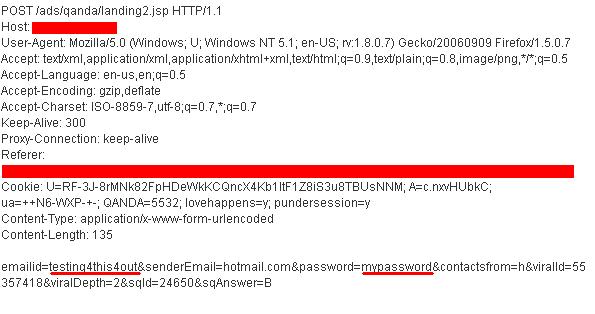
To provide solid proof for this I conducted a little experiment. For the purposes of this, my e-mail will be "testing4this4out" and my password "mypassword". I filled that info in while having a packet sniffer running in the background. The result? As soon as I clicked the submit button I got the following screen in the sniffer...


(If it's too small for you to read, click on it and you'll get the larger version)
As you can see, my e-mail and password appear before you. If this was real life, I would be totally compromised. End of Story.

To conclude, I find it preposterous being asked for my password by a third-party. Moreover when that party does nothing to protect such sensitive information. It seems that we have to look out for ourselves and be constantly on our toes to avoid, the least, an unpleasant situation.

Saturday, September 16, 2006

Wireless Security Revised

There have been talks and talks about Wireless Security but what does the average user know and, more importantly, what does he apply?

Last night I logged in a popular technology forum. It's one of those places where users talks with users and help each other.

A while ago there was a talk (in another forum) I participated in which examined whether forums are the new generation of information or just Unreliable Gossip 2.0. From one point of view, forums allow and promote freedom of speech. Anyone from anywhere may say what he/she has to say. No borders, no boundaries and no censorship. On the other hand, that uncontrollable model of information is susceptible to the "psychology of the group". This means that rumors can easily spread, facts can be twisted and ultimately have dozens or hunders or thousands of people misinformed (I might say deceived) just because "everybody else thinks so". That's the problem right there.

When it comes to critical user-to-user advice, how sure can one be he's getting the right info?

Now, let's get back to the popular technology forum and yet another Thread on Wireless Security. A lot of people in there consider WEP secure, some suggest disabling DHCP and applying a hidden SSID setting and the majority considers MAC Filtering as an effective action. Of course the above will only keep out of a Wi-Fi Network users with the same intellectual level as the ones proposing them. Then again such users don't attack other networks. If they are lucky, when they turn on the computer, it will automatically associate to a network and get an IP through DHCP. Determined attackers on the other hand may penetrate these protective measures in no time.

That's why I consider these tips more dangerous and harmful than any malicious hacker.

The reason is they provide a false blanket of security. Most of these people think "if user1 and user2 suggest them, it's ok". Then, these people, when asked by others to contribute, will replay the same false information as if it was their own, completing an endless loop. Finally a more literate user mentioned WPA/WPA2. That's pretty good unless you use a common dictionary word or name as your Pre-Shared Key.

To sum up, it has been my intention to illustrate the present situation among "user communities" on (wireless) security issues. I would never trust (or at least accept "as-it-is") information from Bob235 or PurpleBeast (the names are fictional), why would you?

Friday, September 15, 2006

Detecting Tor

Talking about Tor with RSnake has produced some interesting points:

First of all, the use of Tor can be detected. In detail, Privoxy - a proxy working with Tor to provide web surfing anonymity - tends to block certain website elements that may blow a user's "cover". Such behavior can be monitored by a website to determine whether a visitor is under a cloak of invisibility or not.

Also, as pointed out, Tor network uses the domain extension .onion (like .com). Of course that is inaccessible outside the network so there you have it, another detection way. If such page gets a hit, the user is using Tor. Of course the user's anonymity is not compromised in any way since one can never be sure about the given IP. Yet this method is a potential tool for content providers who aim in restricting access to identifiable users.

Tor still remains one of the best ways of operating in insecure networks.

Thursday, August 24, 2006

Windows: Vulnerable by Design

I'm coming around one of my (and probably your) favorite subjects, Windows and Their Evil Nature. Talking about this OS and how it is so insecure is one hot topic. It's just I've never sat down to write a few pointers on the subject. And guess what! Tom Yager in InfoWorld has done it for me. Oh boy!! Anyway :P

Just a few quotes from the article...
  • All Windows background processes/daemons are spawned from a single hyper-privileged process and referred to as services.
  • By default, Windows launches all services with SYSTEM-level privileges.
What this means is that if an attacker finds a flaw in a Windows process and manages to inject code, it will be executed with SYSTEM privileges. Bad bad thing! Btw, do you know the average number of flaws/bugs per line of code? Google it and you'll be surprised with the answer.
Another thing I'd like to add is that all these high-priviledged services are running by default in any system. What this means? That all of us have more that a dozen running services which we will never need but at the same time pose a great security risk because of a potential exploit in them!
  • Windows requires that users log in with administrative privileges to install software, which causes many to use privileged accounts for day-to-day usage.
This is so common that most of you think of it as standard. No! Using your computer with an administrator account is also a bad bad thing. Why? Because if malicious code is executed somehow in your account it will have admin rights and believe me a large (maybe the largest) portion of malcode needs these rights. You think you are smart enough? Think again. I am not talking about clicking .exe files sent to you over IRC. I am talking about XSS running javascript, remote code execution exploits and many more. Even a simple .bat written by some brat with cp and rm commands aiming to mess up your system. Unfortunately if you switch to a user-level account you will feel disabled most of the time. Well you shouldn't be.

I could talk about these things for days but I guess it's a good time to stop now, just for today. If you find these interesting go on and read the article.

Oh, Slackware >> Windows :P